“Through the years, the Lord hath done great things for us, whereof we are glad.”
The Founding Years (1928–1929)
New Umbria Baptist Church traces its beginning to a Sunday in June 1928, at the height of the Great Depression, when money, materials, and manpower were all in short supply. It was in this climate that the late Rev. A. L. Simmons founded Umbria Baptist Church, holding its first worship service as a Sunday school with eleven people in attendance at 4658 Canton Street.
That first gathering included Rev. Simmons, his wife Ollie, and their children John and Beatrice; Daniel Davis and Anna L. Davis with their daughters Bertha and Annabelle; Carrie Maude Calhoun and her children Sara, Minnie, and Elizabeth. Ollie Simmons was appointed the church’s first Sunday school superintendent and treasurer.
Rev. Simmons set out to bring the Christian message to the surrounding community and to build a fellowship that would gradually extend the Kingdom of God in the area. As attendance grew beyond the capacity of his home, services moved to the home of the late Daniel Davis at 4664 Canton Street. Neighbors throughout the community joined the congregation, among them Mr. and Mrs. Cain Robinson and their children Rutherford, William, and Foresthe, and Mr. and Mrs. Wise and their children Marie, Lilly, and Eva.
As the congregation continued to grow, it moved in the fall of 1928 to a former mill building at 4616 Umbria Street. Mr. Ed Toles led the committee that secured the property, known as the “Old Mill,” for the congregation’s use. It was during this period that Rev. Simmons fell ill during the church’s first baptism service, held at Galilee Baptist Church in Roxborough. He resigned shortly thereafter due to his illness.
Rev. Simmons was succeeded by Rev. Frank Peterkin, under whose leadership, and that of Chapel Baptist Church, the membership grew substantially. On October 16, 1929, Rev. Peterkin convened a council, with Rev. Smalls presiding as moderator, to formally organize the congregation under the name Umbria Baptist Church.
Establishing the Church’s Foundations
With its name and organization formalized, the church elected its founding officers and established its auxiliary ministries:
- Founding Elected Officers: the late William Dupree, Shelly Seaport, Thomas Howard, James Wise, Beechman Dixon, and Daniel Davis
- Deacon Board: the late Bro. William Dupree, serving as founding chairman and Sunday school superintendent
- Founding Trustees: Edward Toles, John Hill, Cain Robinson, Abraham Green, and Godfrey Dixon
- Founding Musician and Choir Director: the late Sis. Flora Thornton-Howard, organist
- The Willing Workers Club
- Founding Usher Board: the late Sis. Sara Roberts, the late Sis. Elizabeth Robinson, the late Sis. Laura Brown, and the late Sis. Anna L. Davis, who encouraged Sis. Roberts to serve as an usher
- First Church Mother: the late Sis. Carrie Hunter
The first Missionary Society was formed in 1929 under the presidency of Sis. Bell Seaport, and a Foreign Mission Fund was established soon after. In October 1939, Umbria Baptist Church became affiliated with the Pennsylvania State Convention. Throughout these early, lean years, founding trustees John Hill, Edward Toles, Elson Hill, and Cain Robinson made significant financial sacrifices to keep the church moving forward.
A Succession of Faithful Pastors (1935–1955)
The church was served through the following two decades by a succession of dedicated pastors:
- Rev. William Peterkin (1935)
- Rev. M. Taliferro (1935–1937)
- Rev. J. P. Green (1937–1939), under whose leadership the Junior Usher Board was organized in December 1938
- Rev. J. H. Locus (1939–1941), under whom the Junior Church began on March 22, 1939, with its own elected officers. On September 25, 1940, the church body unanimously approved that the founders’ names be entered into the official record.
- Rev. William Jackson (1941–1945), under whom renovation of the church building began in late 1945
- Rev. J. J. Grantham (1946–1952), who worked tirelessly on continued renovations and oversaw growth in both membership and financial stability
- Rev. E. Payne (1952–1955), during which the church continued to move forward
A New Name and a New Home (1955–1966)
In 1955, Rev. Donald E. Alexander became pastor. Under his leadership, the congregation voted to change the church’s name to New Umbria Baptist Church, reflecting plans to relocate. Rev. Alexander’s vision guided the church to its present location at 4147–49 Main Street in Manayunk, and under him the congregation reorganized its auxiliaries and established anniversary observances for each. The church was formally chartered and incorporated under the Commonwealth of Pennsylvania.
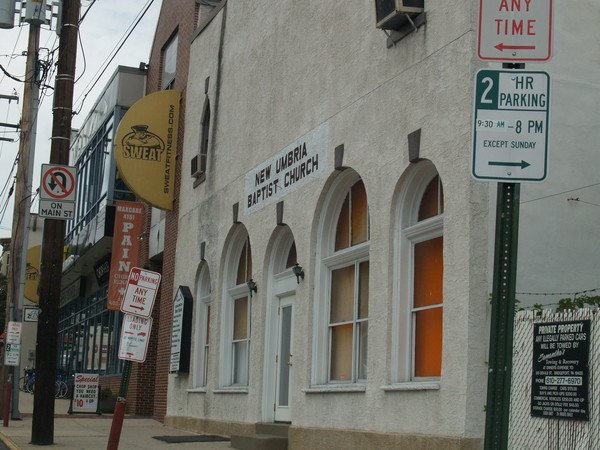
Rev. Alexander secured the purchase of the properties at 4147–49 Main Street and the adjoining apartment building at 4143–45 Main Street, at a combined cost of $58,700. Historic-property records show the 4147–49 Main Street building had originally been constructed as a restaurant, not a church, standing within what is now the Main Street Manayunk National Historic District. Its original brick front was later resurfaced in white stucco, though several older architectural details survive today, including rounded-arch window and door openings and a keystone ornament above each arch. On September 30, 1962, the congregation marched from 4616 Umbria Street to its new edifice, with the choir singing as members followed behind. The dedication service opened with prayer from Rev. Julius Williams, joined by other guest speakers.
Under Rev. Alexander’s magnetic leadership, both morning and afternoon services were well attended, and the church realized many of its long-held aspirations. He was affectionately and widely respected throughout Manayunk, Roxborough, and Philadelphia as a gifted organizer, builder, and leader devoted to reaching men, women, and children with the message of Jesus Christ. By the time Rev. Alexander went home to be with the Lord in August 1966, the church had paid off all but $6,000 of its mortgage.
The Legal Record: Incorporation and Recognition (1958–1964)
Though the congregation had organized itself spiritually in 1929, its formal legal existence came decades later. Articles of Incorporation for “The New Umbria Baptist Church” were filed with the Court of Common Pleas No. 2 for Philadelphia County in September Term 1958, docketed as No. 257. The court’s decree approving the incorporation was entered on July 28, 1959, and recorded that August. At the time of filing, the church’s registered office was listed at 4618 Umbria Street.
The Articles name the incorporators who signed the church into legal existence: Rev. Donald E. Alexander, Henry Brown, Rutherford B. H. Robinson, James E. Overstreet, Charles N. Griffin, James Griffin, Louis C. Johnson, Nancy Overstreet, William Q. Randall, J. D. Overstreet, J. D. Clark, Daniel Barksdale, Vannie Knight, Emmett Johnson, William L. Robinson, Willie Clark, Clarence Roberts, George Clark, and John R. Griffin. The founding Board of Trustees named in the same document included Rutherford B. H. Robinson, William Q. Randall, J. D. Overstreet, J. D. Clark, Clarence Roberts, Daniel Barksdale, Vannie Knight, Emmett Johnson, William L. Robinson, and Willie Clark, with the church’s pastor serving as ex officio chairman of the board.
At the time of incorporation, the church held $5,000 in equity, $7,000 on deposit with the First Pennsylvania Company for Banking and Trust, and $1,000 in escrow toward the purchase of a church building valued at $17,000, located at the corner of Silverwood and Green Lane Street. This was not the Main Street property the congregation would ultimately call home in 1962, a reminder that the path to 4147–49 Main Street involved more twists than the final result suggests.
The Main Street home became official in the eyes of the city not long after. A letter dated January 29, 1964, from the Philadelphia Board of Revision of Taxes confirmed that the premises at 4147–49 Main Street, held by New Umbria Baptist Church, Inc., were granted tax-exempt status for 1963 and thereafter, recorded under Ward 21, Exemption #262, and Account #1914.
Continued Growth and Ministry (1967–2008)
Rev. Joseph Whitaker succeeded Rev. Alexander, pastoring from 1967 until his passing in 1971. During his tenure, he organized the Martin Luther King Scholarship Fund, reorganized the Junior Choir, and was widely regarded as a devoted “Gospel Preacher” known for his faithful ministry to the sick and shut-in.
Rev. Dr. Robert P. Shine arrived to pastor the church during a period of transition, bringing with him a rare combination of spiritual leadership and business acumen. Under his guidance, the church completed much-needed renovations, approved an administrative staff, cleared the existing mortgage, and purchased a Baldwin organ. He established the church’s first tape ministry, its newsletter, and a bus ministry. The first Youth Mass Choir was formed under the direction of the late Rachel Felder, the church sent its first student missionary abroad to Haiti, and several members enrolled in evening classes at the Manna Bible Institute.
Rev. Wilkins O. Jones, who had served as the Senior Choir’s organist, became interim pastor in 1985 and was unanimously elected pastor in January 1986. Missions and missionary giving flourished under his leadership, the church’s administration was restructured, and a new church van was obtained in 1987. Rev. Jones was especially beloved among the youth.
Rev. William Flemings, Sr. served as interim pastor before his unanimous election in 1989. He led the re-lighting of the church’s cross, an act that inspired the congregation, and oversaw the installation of new cushions for the church pews. In 1995, under Glennie Tynes, the Youth Ministry was reorganized, and in 1997 the Hospitality Club was reorganized with Sis. Eva M. Johnson elected president and Sis. Arrita Robinson elected vice president. Drums were added to the Music Ministry in 1998, and in 2001 Rev. Fleming wrote and introduced the church’s theme song, “Unity.” In 2002, through Deacon Calvin Clark’s fundraising efforts, the church acquired a baby grand piano and completed renovations to Unity Hall. Rev. Fleming’s tenure, from 1989 to 2006, was the longest in the church’s history.
Bishop-Elect Xavier J. Brand served as interim pastor before his election in September 2008. During a period of transition, he helped reestablish the church’s Community Outreach ministry. Deaconess Barbara Knight was named Mother of the Church following the passing of the beloved Beatrice Griffin. Bishop-Elect Brand pastored faithfully from 2008 to 2009.
Perseverance Through Transition (2009–2013)
While the church searched for its next shepherd, Arrita Robinson served as worship leader. During this season, refurbished computers were given to the church’s senior members, and the Giving Ministry was reestablished. The congregation continued to serve and pray in unity, maintaining its Annual Days and fellowship traditions. Rev. Dr. Robert Collier and Galilee Baptist Church served as mediators for pastoral services during this time, and Rev. Dr. Collier came to be fondly known as “the Father” for his willingness to support New Umbria in its time of need.
Rev. Darren W. Croft served as interim pastor before his unanimous election in November 2010, pastoring faithfully through 2013. Under his leadership, the church reestablished its community outreach and evangelism efforts.
In September 2013, the congregation, again in transition, unanimously elected one of its own sons in the ministry, Rev. Charles M. Jones, to lead New Umbria Baptist Church, bringing his combination of leadership and business acumen to a congregation still thriving within the Manayunk community.
The Church’s Final Chapter (2017–2026)
Rev. Charles M. Jones resigned as pastor in December 2017. Following his departure, Rev. Dr. Robert P. Shine Sr. was elected to once again lead New Umbria Baptist Church, returning to a congregation that by this time had been diminished, with its property in a state of partial disrepair.
In 2018, Rev. Dr. Shine brought in a crew from a nonprofit church rehabilitation organization on two separate occasions to begin cleaning and repairing the building. Despite these efforts, the congregation, by then reduced to seven remaining members, made the difficult decision that the church property would need to be sold.
As of 2026, the church edifice at 4147–49 Main Street in Manayunk stands quiet, its doors no longer open for worship, fellowship, and community service that defined it for nearly ninety years.
A Lasting Legacy
Across nearly a century, the young people of New Umbria Baptist Church carried forward the traditions passed down by their forebears, many going on to notable careers and vocations. The church’s Music Ministry earned wide recognition under the late organist James A. Jones, and produced such talents as the legendary Robinson Sisters (formerly the New Umbria House Wreckers), the Gospel Chorus, concert soprano Willa Mae Brown Royster, and award-winning concert pianist Charles Pettaway. Family United, along with descendants of the Robinson Singers including Vincent Weldon and Jay Jones, all trace their roots back to New Umbria.
The church was also served through the years by many faithful and loyal ministers devoted to its mission, including Rev. Thomas, Rev. William Francis, Rev. Frederick Felder, Rev. Paul Clark, Rev. James Bing, Rev. Robert Taylor, Rev. Julius Williams, Rev. J. Glen, Rev. Albert Roberts, Rev. Harry Campbell, Rev. Louis Earls, Rev. John Whitaker, Rev. Jimmy Johnson, Rev. Guy Minott, Rev. Beale, Rev. William Fuller, Rev. Colzie, and Rev. Charles M. Jones.
This history was originally compiled by the late Foresthe Overstreet, the late Sis. Annabelle Overstreet, the late Sis. Sarah Robert, the late Rutherford Robinson, the late Rachel Felder, Sis. Elizabeth Talley, Sis. Elayne Turner, Sis. Dolores Dennis, and Sis. Arrita Robinson.