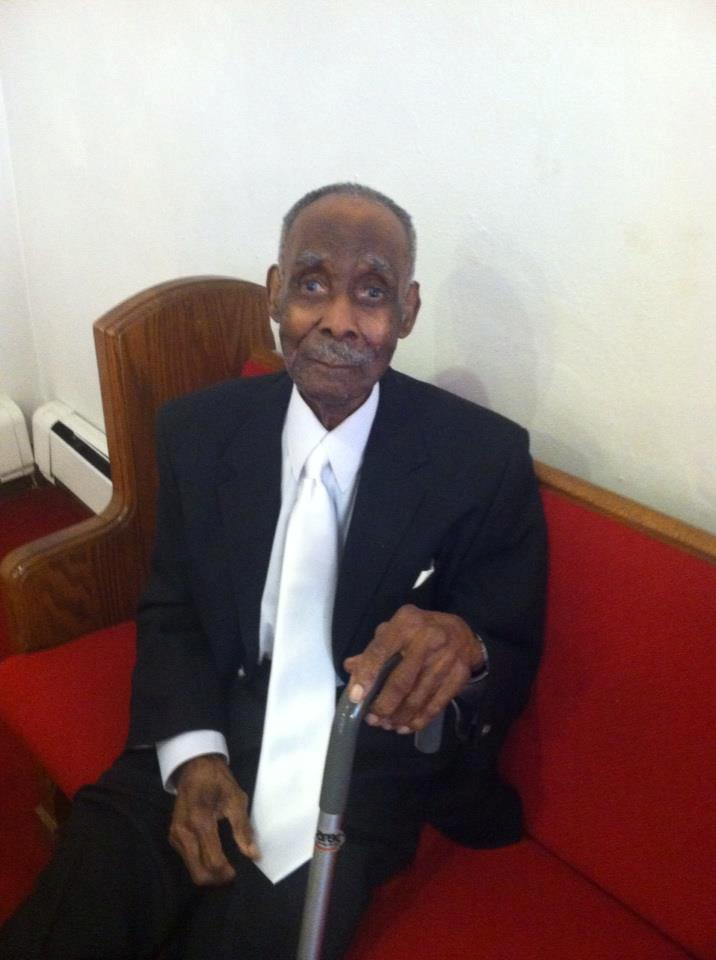
Deacon Major Overstreet sitting on the back pew in the interior of New Umbria Baptist Church
Credit: New Umbria Baptist Church photo – Roxborough Manayunk Wissahickon Historical Society
Long before Manayunk became known for its bars, boutiques, and bike trail, it was a mill town. Water from the Schuylkill River and the Manayunk Canal turned wheels that spun cotton and wool into cloth, and that industry shaped nearly everything about the neighborhood, including where its people worshiped.
That is where the story of New Umbria Baptist Church truly begins.
A Congregation Born in a Mill Town
When Rev. A. L. Simmons founded the church in June 1928, Manayunk had already been a working mill community for more than a century. The first mill along the canal opened as early as 1819, and by the mid to late 1800s the neighborhood was packed with textile operations, four- and five-story brick buildings running block after block along the water. Families came from England, Ireland, and Germany, places where mechanized textile work was already a way of life, drawn by the promise of steady mill jobs. Unlike the big corporate mill towns like Lowell, Massachusetts, Manayunk’s mills tended to be smaller, family-owned operations, which gave the neighborhood a tighter, more personal industrial culture.
Most of what has been written down about Manayunk’s mill workforce centers on the families who came from England, Ireland, and Germany, immigrants who arrived already trained in mechanized textile work and who left behind a well-documented paper trail of names, wages, and church rolls. What has gone largely unwritten is another migration that shaped the same streets: the Great Migration of Black families out of the American South, seeking work, safety, and opportunity in northern cities like Philadelphia. Between 1900 and 1920 alone, Philadelphia’s Black population more than doubled, and that wave of arrivals reached neighborhoods across the city, including mill communities like Manayunk. This is, in large part, the untold reason Black Manayunk exists at all. The founders of Umbria Baptist Church, men and women who had made their way north and found work in the same mills that lined Umbria Street, were part of that larger, largely undocumented story. Their labor helped run the same industry credited almost entirely to European immigrant families in the official record, even as their own history was rarely written down alongside it.
By the time the young congregation outgrew Rev. Simmons’s home and the home of the late Daniel Davis, it needed a bigger space. In the fall of 1928, the church found one in a former mill building on Umbria Street, a structure the congregation always simply called “the Old Mill.” Mr. Ed Toles led the effort to secure the rental, and the church held services there through its first baptism and into its formal organization as Umbria Baptist Church in October 1929.
It was more than a convenient roof. Many of the church’s own men worked in the mills that lined Umbria Street and the surrounding blocks, the same industry that built the neighborhood around them. Worshiping inside a mill building was not incidental. It reflected the daily life of the congregation itself, families whose weekdays were spent among looms and spinning frames finding their Sunday fellowship inside the very kind of building that fed and sustained them.
Umbria Street’s Industrial Heart
Umbria Street, originally called Washington Street before being renamed in the early 1900s to reflect the neighborhood’s growing Italian immigrant population, sat at the center of Manayunk’s mill district. Builders like Samuel Streeper Keely, who opened a lumber and building supply company at Leverington Avenue and Umbria Street in 1845, helped raise many of the mills that defined the area, including Economy Mills, the Lincoln Mills, and the Rice and Bean Harmony Textile Mill. Nearby, the Manayunk Plush Manufacturing Company built a substantial new mill and power house along Umbria Street in the 1920s, right around the same years the young congregation was meeting a few blocks away.
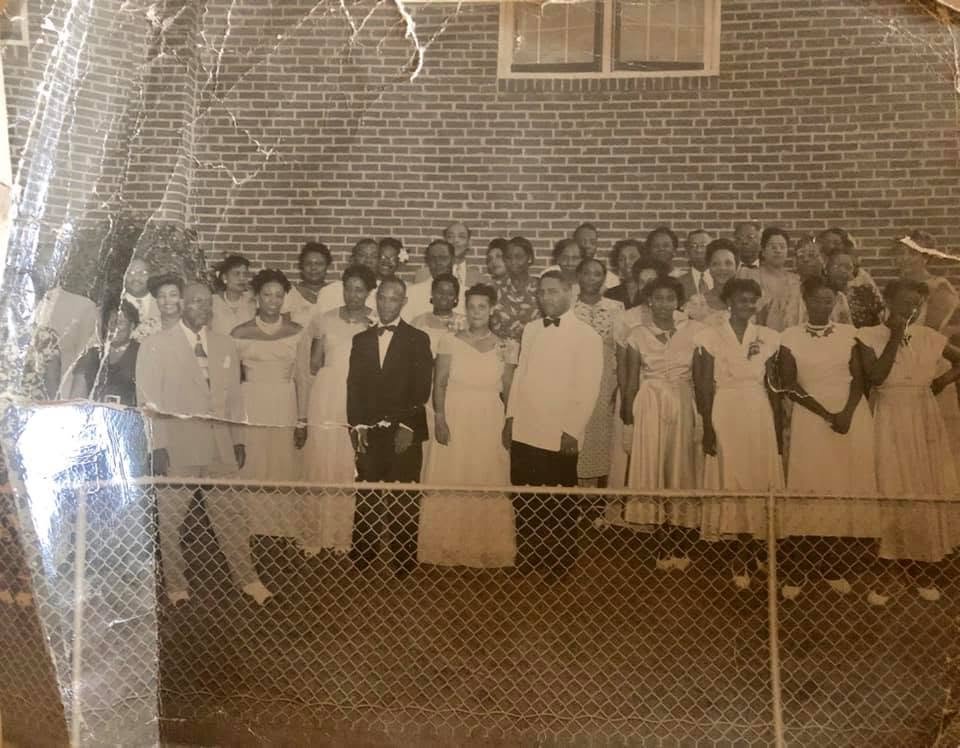
These were not small operations. Mills like Sevill Schofield’s Economy Mills, just down toward the canal, employed hundreds of men, women, and children spinning wool and cotton and weaving cloth, and the industry as a whole was the economic backbone of Manayunk for generations. For the men of the congregation who clocked in at those mills each week, the Old Mill building on Umbria Street would have felt like familiar ground, brick walls, high ceilings, and the same kind of structure they spent their working lives inside, only now filled with prayer instead of machinery.
When the Mills Went Quiet
Manayunk’s textile industry did not last forever. Through the middle of the twentieth century, competition, changing technology, and the broader decline of American textile manufacturing closed mill after mill along the canal. Buildings that once employed hundreds sat empty. By the time New Umbria Baptist Church relocated to its present home at 4147-49 Main Street in 1962, much of the mill economy that had shaped its earliest years was already fading.
What happened next mirrors a pattern seen across the neighborhood. Many of Manayunk’s old mills sat vacant for years before developers began converting them into apartments, artist studios, and mixed use spaces starting in the late twentieth century. Places like Canton Mills, once a textile powerhouse, now house creative studios and galleries. Others became loft apartments as demand for housing in the walkable, historic neighborhood grew. The Keystone Mill on Leverington Avenue stood for decades as a landmark of that transformation, industrial buildings finding new purpose long after the machines fell silent.
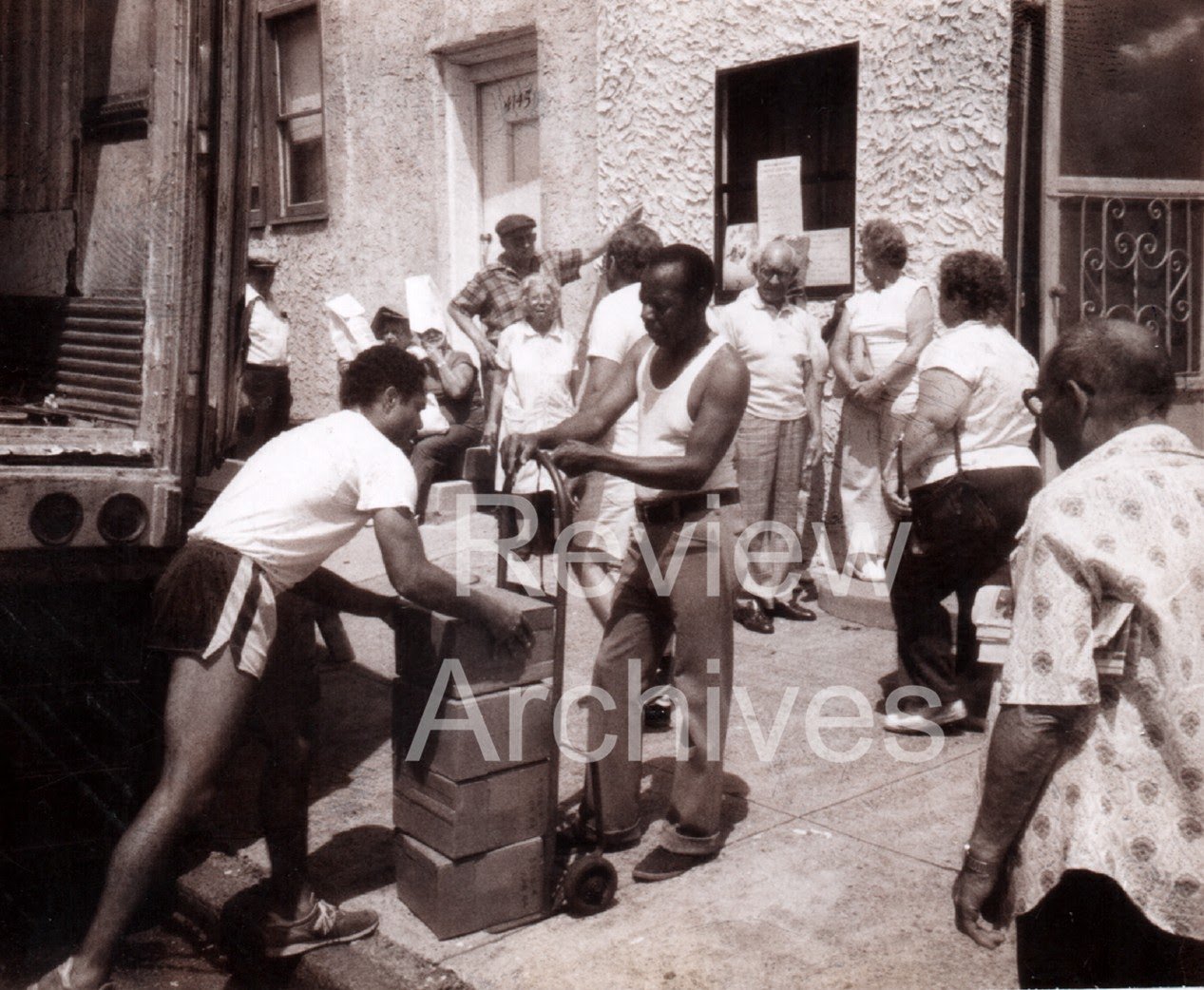
Credit: Roxborough Review. Trustee J.D. Overstreet unloading for the Food Ministry. Location at New Umbria Baptist Church.
A Parallel Story
There is something fitting, and something sobering, about the way New Umbria Baptist Church’s story echoes the mills that once surrounded it. The congregation began inside a mill building at a moment when Manayunk’s textile industry was near its peak. Decades later, as the mills emptied out and the neighborhood reinvented itself around new uses for old buildings, the church itself experienced its own long season of transition, changing pastors, changing membership, and eventually the same kind of vacancy that once defined the mill district.
Following Rev. Charles M. Jones’s resignation in December 2017, Rev. Dr. Robert P. Shine Sr. returned to lead a congregation that had grown small and a building that had fallen into partial disrepair. In 2018, he brought in a crew from a nonprofit church rehabilitation organization on two separate occasions to try to clean and restore the space. But with only seven members remaining, the congregation made the difficult decision that the church would need to be sold.
As of 2026, the church at 4147-49 Main Street sits quiet, much like the mills that once lined Umbria Street before the neighborhood found new life for them. Manayunk has a long history of empty industrial buildings eventually finding a second purpose. Whether that same story awaits the church that began its life inside one of those mills remains to be seen.
What the Documents Show
Beyond memory and oral history, the church’s own paper trail fills in details that sharpen this story and, in one case, correct an assumption worth clearing up.
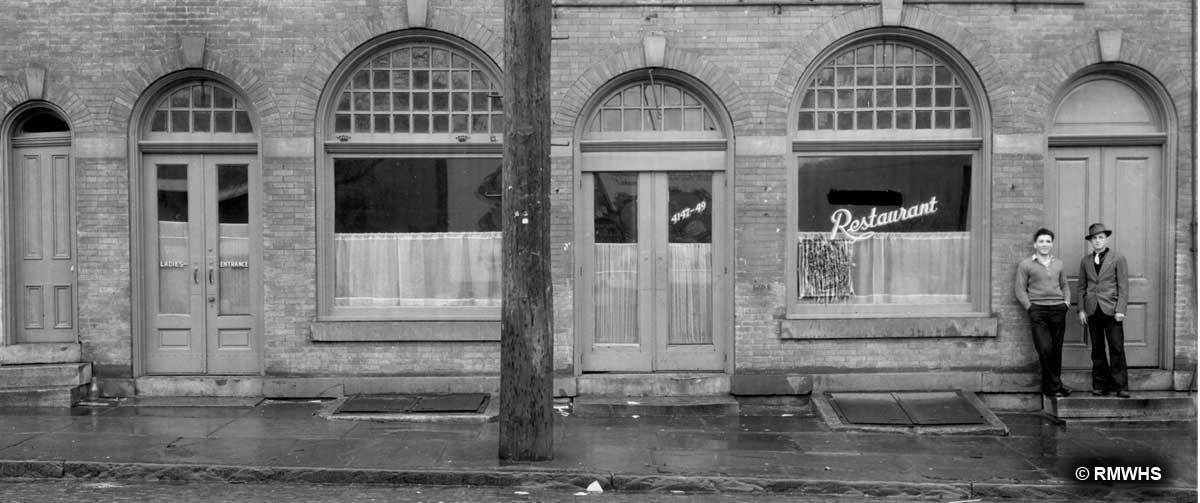
The Main Street building was not originally built as a church. Historic-property records for 4147-49 Main Street show the building started out as a restaurant, sitting within what is now the Main Street Manayunk National Historic District, the same commercial corridor that grew directly out of the neighborhood’s mill economy, lined with the stores, banks, hotels, and warehouses that served the mill workforce. The original brick front was later resurfaced in white stucco, but several older architectural details survive today: rounded-arch window and door openings and a keystone ornament set above each arch. New Umbria Baptist Church did not build this structure. It moved into it, giving a former restaurant a second life as sacred space, much the way the congregation’s first home gave a former mill the same second life a generation earlier.
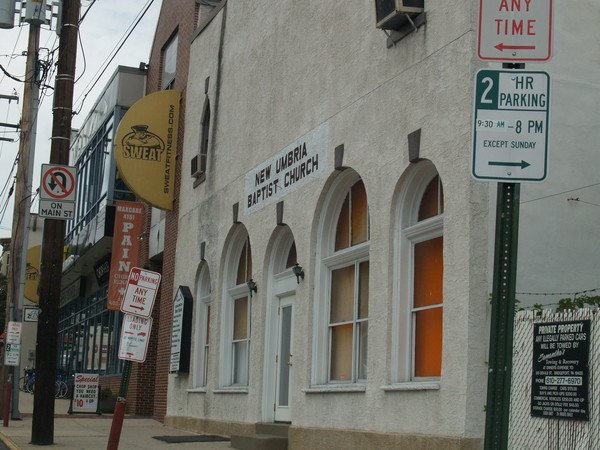
New Umbria Baptist Church 4147-49 Main Street.
Formal incorporation came three decades after founding. While the congregation organized itself spiritually in 1929, it was not legally incorporated as “The New Umbria Baptist Church” until years later. The Articles of Incorporation were filed with the Court of Common Pleas No. 2 for Philadelphia County in September Term 1958, and the court’s decree approving the incorporation was entered on July 28, 1959, recorded that August. At the time of filing, the church’s registered office was listed at 4618 Umbria Street, just doors from the Old Mill building the congregation had occupied three decades earlier.
The incorporators and trustees were neighborhood people. The Articles name the men and women who signed the church into legal existence: Rev. Donald E. Alexander, Henry Brown, Rutherford B. H. Robinson, James E. Overstreet, Charles N. Griffin, James Griffin, Louis C. Johnson, Nancy Overstreet, William Q. Randall, J. D. Overstreet, J. D. Clark, Daniel Barksdale, Vannie Knight, Emmett Johnson, William L. Robinson, Willie Clark, Clarence Roberts, George Clark, and John R. Griffin. Their listed addresses, Canton Street, Linney Street, Silverwood Street, Sharpnack Street, Roxborough Avenue, Hortter Street, Dupont Street, place them squarely within the same mill-adjacent streets that had housed generations of Manayunk’s working families. The founding Board of Trustees named in the same document included Rutherford B. H. Robinson, William Q. Randall, J. D. Overstreet, J. D. Clark, Clarence Roberts, Daniel Barksdale, Vannie Knight, Emmett Johnson, William L. Robinson, and Willie Clark, with the church’s pastor serving as ex-officio chairman of the board.
The congregation was already planning ahead. The 1958 Articles note that the corporation began its legal existence holding $5,000 in equity plus $7,000 on deposit with the First Pennsylvania Company for Banking and Trust, along with $1,000 held in escrow toward the purchase of a church building valued at $17,000 total, at the corner of Silverwood and Green Lane Street. That property is not the Main Street address the church would ultimately call home in 1962, a reminder that the congregation’s path to 4147-49 Main Street involved more twists and considerations than the final result suggests.
The Main Street home became official in the eyes of the city. A letter dated January 29, 1964, from the Philadelphia Board of Revision of Taxes to Mr. Charles W. Bowser confirmed that the premises at 4147-49 Main Street, now held by New Umbria Baptist Church, Inc., were granted tax-exempt status for 1963 and thereafter, recorded under Ward 21, Exemption #262, and Account #1914. Just two years after the congregation’s 1962 march to its new home, the church’s presence there was formally and permanently on the record.
Why This History Matters
New Umbria Baptist Church was never separate from the industry that built Manayunk. It grew up inside it, literally. The men who filled its pews were often the same men who filled the mills, and the building the congregation first called home was a direct product of the same textile boom that put Manayunk on the map. Telling the story of the Old Mill is not a side note to the church’s history. It is part of the foundation the church was built on, brick by brick, alongside the neighborhood it served for nearly a century.
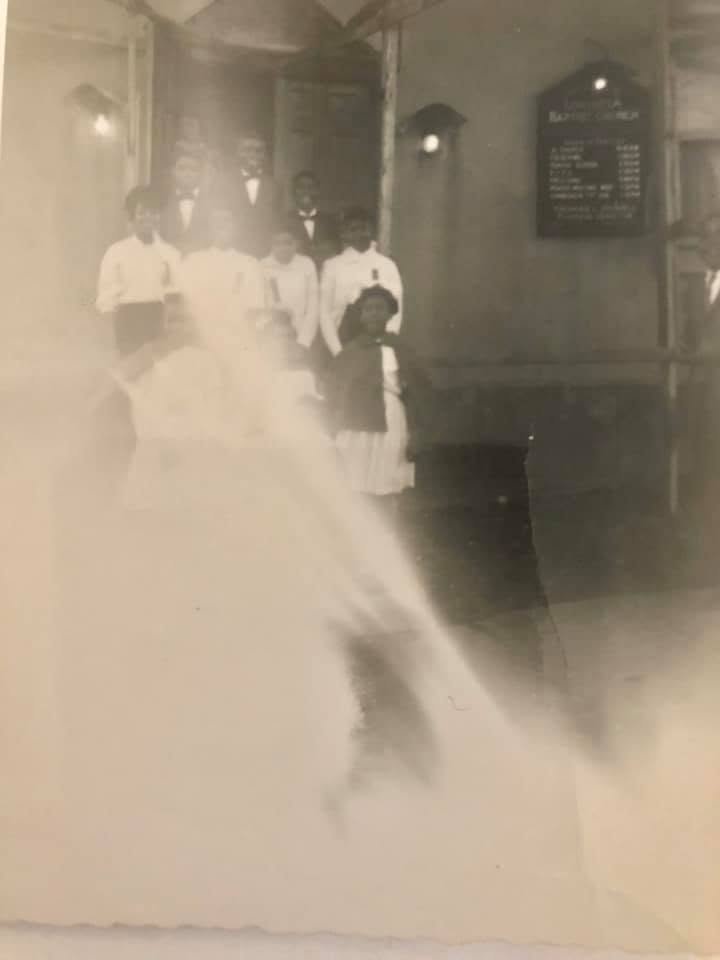
Umbria Baptist Church on Umbria Street