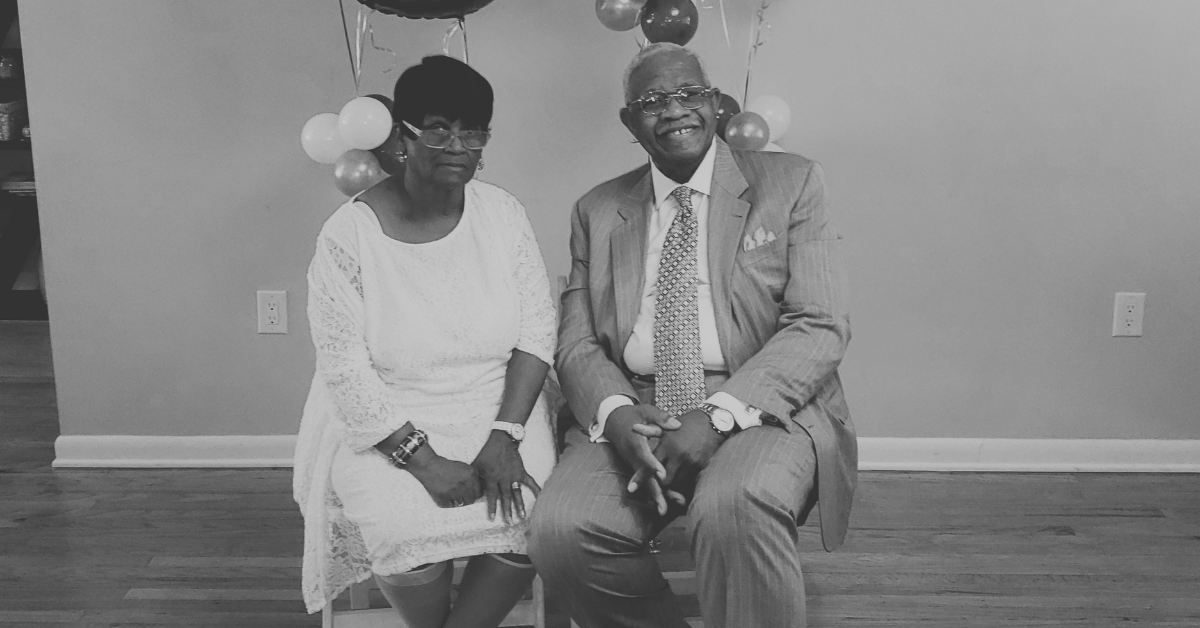
On this episode of Black Manayunk Stories, host Arrita Robinson sat down with Robin Shine Maddox, CEO and founder of She Shines Sisterhood, to celebrate the heavenly birthday of her mother, Sister Barbara Shine. What began as a tribute to one woman’s life became a window into a family whose ministry shaped Manayunk and Roxborough for a generation, and whose story is deeply woven into the history we’re working to preserve.
Growing Up a Preacher’s Kid
Robin and Arrita spent part of the episode reminiscing about what it meant to grow up as a “PK,” a preacher’s kid. There was no clocking out. Robin and her siblings were always the first ones at New Umbria Baptist Church to unlock the doors, and the last ones to lock up and leave at night.
She shared a memory that will feel familiar to anyone raised in a preacher’s household: her father coming into the children’s bedrooms late at night, his deep voice announcing that the Lord had called him to preach. Reverend Shine always told it as though his kids sat straight up in excitement. Robin remembers it a little differently. Mostly, she remembers being sound asleep.
A Neighborhood Built Around the Church
What stood out most in the conversation was how much of the Black community life in Manayunk and Roxborough ran through New Umbria. The church bought a van specifically so Robin’s mother could round up every kid in the neighborhood and bring them to church, making sure her own children’s friends were always right there beside them.
Sunday dinners ran on a schedule of their own. Church families took turns hosting the pastor’s family for meals between the morning, afternoon, and evening services, a rotation that turned Roxborough Avenue, Canton Street, and Cresson Street into a web of open kitchens and shared tables. And when it came to music, the Robinson family carried the choir. Robin jokes that being born a Robinson meant you came out already knowing how to sing.
Mother Shine
Barbara Shine earned her nickname the way most beloved community figures do by showing up. She worked in the Philadelphia public school system, but her real reach went further. She built the church’s youth choir into its largest ever, mostly by personally picking up children and bringing them into the fold. She looked after the neighborhood’s elders with the same steadiness. And through missionary work, she formed a lasting bond with a young girl in Africa, adopted through a Christian missionary organization, exchanging letters and gifts with her for years.
The Day Everything Changed
The most difficult part of the conversation centered on a single afternoon in 1971. Robin’s family was driving down Shurs Lane toward Main Street, headed to church, when police aggressively stopped them in a predominantly white area of the neighborhood. Reverend Shine identified himself as the pastor of New Umbria Baptist Church. Officers pulled him from the car and beat him in front of his wife and four children.
Robin points to that moment as the exact turning point in her father’s life’s work. From then on, he became one of Philadelphia’s most consistent prophetic voices for civil rights, not only for Black and Brown communities, but for Asian and transgender communities as well.
Who Was Rev. Dr. Robert P. Shine, Sr.?
Robert P. Shine Sr. was born in Philadelphia on August 4, 1939, the 14th of sixteen children born to Benjamin and Estelle Shine. Raised in Germantown, he began preaching at age eight, standing on a milk crate because he was still too small to be seen otherwise. He met his wife, Barbara Ann Wayns, at Germantown High School, and their marriage lasted until his death.
In 1971, after being ordained by the late Rev. George Lyshon, Shine accepted the pastorate at New Umbria Baptist Church in Manayunk, where he would serve for fifteen years. During that time, he also planted a church in Kingston, Jamaica, a ministry he and Barbara returned to every summer.
In 1985, Shine gathered a small group of believers, just over 25 people, and founded Berachah Baptist Church in West Oak Lane, where he would serve as pastor for the next 35 years. Berachah means “blessing” in Hebrew, a name Shine chose even though the young congregation was, in his own words, virtually penniless at the time.
Beyond the pulpit, Shine’s influence reached deep into Philadelphia’s civic life. He served as president of the Black Clergy of Philadelphia and Vicinity, sat on the board of the Philadelphia Martin Luther King Jr. Center, and chaired the Manna Bible Institute’s board until his death. He regularly met with police officials and city leaders to address police shootings of unarmed residents, work that echoed forward decades after his own encounter with police violence on Shur’s Lane. In 2014, he wrote a position paper on policing practices for former Philadelphia Police Commissioner Charles Ramsey, who later chaired President Obama’s Task Force on 21st Century Policing. In 2003, as president of the Black Clergy, he led protests against a Center City store selling a board game called Ghettopoly.
Rev. Dr. Robert P. Shine, Sr. passed away on January 4, 2022, at the age of 83, after a short illness. He was remembered by fellow clergy as a man who spent his life pastoring, teaching, and working for justice, in that order and all at once.
A Century of New Umbria
New Umbria Baptist Church, where Robert and Barbara Shine built so much of this legacy, began in 1926 as Umbria Baptist Church on Canton Street before later moving to Main Street. Reverend Shine holds a unique place in its history: he was both the first pastor to serve the Main Street location and the last, as the congregation eventually closed its doors after older members passed on and younger families moved elsewhere. This year, 2026, marks the church’s 100th anniversary, a milestone that makes Robin’s tribute to her mother, and this whole episode, feel especially timely.
Continuing the Legacy
Robin Shine Maddox has carried her family’s spirit of service into her own work as founder of She Shines Sisterhood. The organization’s 7th Annual She Shines Conference is scheduled for November 7, 2026, inspired in part by Robin’s own journey surviving breast cancer. The conference centers on three pillars: health, wellness, and safety; civic engagement; and spiritual enrichment. More information is available at shashinesconference.com.
Stories like this one are exactly why Black Manayunk exists. A church most people have never heard of, a family that shaped a neighborhood one Sunday dinner at a time, and a moment of violence that turned into decades of purpose. This is Manayunk’s history, and it deserves to be remembered.
Have a family story tied to Manayunk or Roxborough’s Black churches, schools, or community life? We’d love to hear it. Reach out through our Get Involved page to share your story or request to be a guest on Black Manayunk Stories.